
There is a killer in the forest and it wears an emerald coat of green. Nibble, nibble. Tiny bites. With stealth, the killer moves methodically from one victim to another. A tunnel here, a burrow there, and without fail, the giants fall.
A little over twenty years ago, ecologists discovered a tiny green insect burrowing beneath the bark of urban ash trees in Detroit, Michigan and Windsor, Ontario. Soon the trees began to wither and die. Known as emerald ash borer (EAB), this non-native invasive insect has since spread to 36 states and 5 Canadian provinces and is poised to decimate the forests of Minnesota.

The larvae of the EAB create winding tunnels under the bark of ash trees, which disrupts the flow of nutrients between trees’ leaves and roots. As an EAB infestation progresses, you’ll start to notice chunks of bark flecking off due to woodpeckers hunting for the larvae underneath. Most ash trees die within one to three years after they begin to show symptoms.


Ash trees are quite common in urban areas, where you can find them in front yards, city parks, and boulevards. In fact, ash comprise 60% of the tree species in many Minnesota communities. In addition, the black ash swamps along the St. Croix River and further north of Washington County are highly vulnerable to EAB infestations.
Though the impacts of emerald ash borer are quite well known, stopping its spread has proven to be nearly impossible. The Minnesota Department of Agriculture has established a quarantine region that covers most of central, eastern, and southern Minnesota, as well as the Fargo-Moorhead and Duluth areas. It is illegal to move ash logs and ash tree waste outside of the quarantine boundaries and recommended to avoid cutting and removing ash branches, trees, and stumps between May and October anywhere in the state to avoid furthering the spread of EAB.
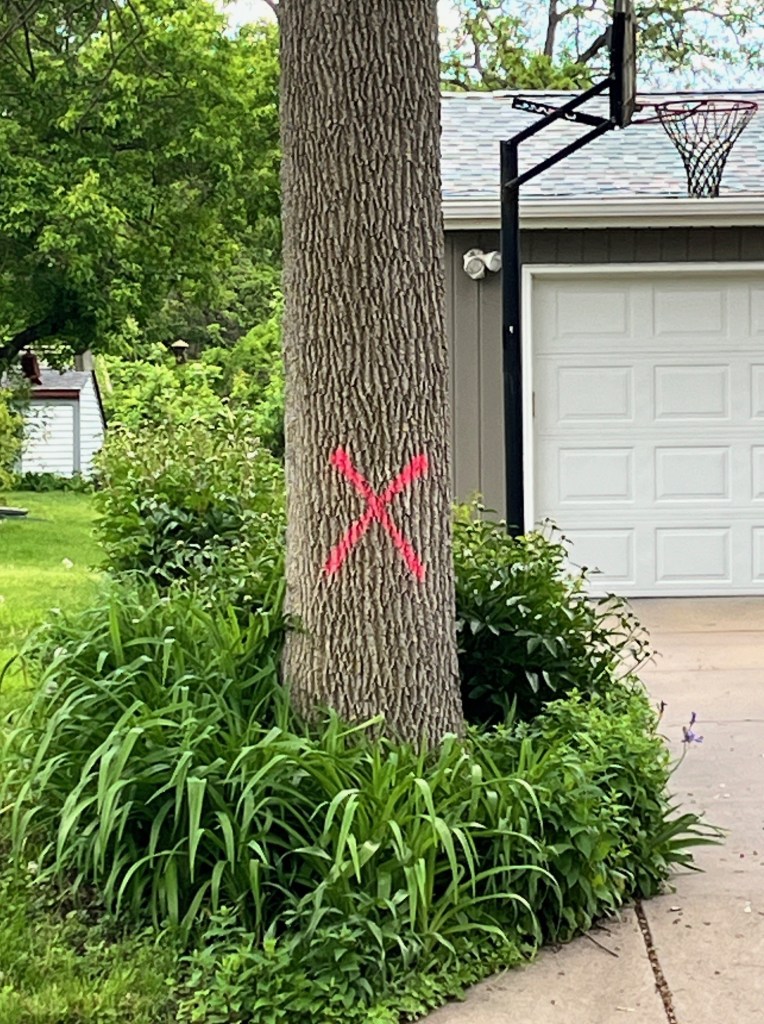
It is possible to treat individual ash trees with an insecticide to protect them against emerald ash borer, however, the treatments are fairly expensive and must be repeated once every two to three years for the entirety of the tree’s life. In terms of biological control, native woodpeckers are the primary predators of emerald ash borers. Researchers are also studying the impacts of non-native parasitoid wasps from Asia, which were introduced to North America in a few locations in 2007 to help control EAB.

If you have black ash wetlands on your property and are looking for new trees to replace lost ash, some of the recommended species include American elm, swamp white oak, hackberry, balsam poplar, silver maple, black spruce, and tamarack. For best success, avoid clear-cutting all of your ash at once. Instead, approach ash replacement as a multi-year project and only remove a few sections of trees per year.

If you’re interested in learning more about caring for your trees and woodlands, join Washington Conservation District, Belwin Conservancy, Minnesota DNR, and Washington County Master Gardeners for a walk in the woods on Tuesday, May 28, 5:30-8:30pm at Belwin Conservancy (1553 Stagecoach Trail S. in Afton). During this fun, interactive workshop, participants will learn about:
- Basic tree identification
- Pests, diseases, drought, and other stressors
- Managing buckthorn, garlic mustard, and other invasive species; and
- Supporting birds and wildlife.
Register at tinyurl.com/2024woodlands. If you can’t make the workshop but are interested in finding local resources and info about emerald ash borer, head to www.mnwcd.org/eab.

 East Metro Water